Cafeterias Unknown
What’s Cooking at Green Street School
NewBrook’s Ladder of Responsibility
Lessons from Chef Dan Giusti


Cafeterias Unknown
What’s Cooking at Green Street School
NewBrook’s Ladder of Responsibility
Lessons from Chef Dan Giusti
How can we teach about large-scale problems—such as climate change—without discouraging students? This question vexes many educators as climate change and sustainability become a more integral part of classroom curriculums. Climate change is a big problem, and our initial instinct may be to lay out all the facts and urgency to our students. Not so fast though, if we only arm our students with the knowledge without also building their capacity to act, we may be discouraging future positive actions to address these important problems.
David Sobel, Director of Certificate Programs at Antioch University New England, has a solution to this dilemma—what he calls a Ladder of Environmental Responsibility. The purpose of this tool is to provide students with concrete tasks which demonstrate that their behaviors can have a positive impact on the environment. These tasks should gradually become more difficult as students move through the grades, be tied in with the existing curriculum, and provide students with nature experiences that help connect them to the environment.

As a part of a recent grant from the Vermont Agency of Agriculture, Food & Markets, Newbrook Elementary’s faculty came together last year to design their own Ladder of Responsibility. They were able to take the principles laid out by Sobel and adapt them to the specific context of their school. Now, Sam Kilmurray, NewBrook’s Garden Educator, is using the ladder as a framework for her Farm to School education.
In addition to a host of shared tasks, there is now a specific track for students as they move from grade-to-grade. For example, Kindergarten is in charge of the pollinator garden, second grade learns about medinicial gardening, and fifth graders are the school’s waste stewards. Not only does this scaffold environmental education for students, but it can also help teachers incorporate Farm to School education—which for some may feel intimidatingly broad—into their classroom curriculum by providing a defined list of tasks for students to participate in.
The Ladder of Environmental Responsibility can easily be adapted to fit within your school’s Farm to School program, provide clarity to your curriculum, and—most importantly—help students grow into empowered environmental stewards. If you’re looking for help to develop a Ladder of Environmental Responsibility for your school, feel free to contact Conor, conor@foodconnects.org.

Student investigates the classroom worm bin. There are six bins in classrooms throughout the school which are a part of the 5th grader’s waste stewardship responsibilities.
Last month our Farm to School team had the pleasure of attending the annual meeting of the School Nutrition Association of Vermont. The meeting was held in Colchester and attended by Child Nutrition Professionals from all over the state with the shared vision that “feeding all children is recognized as an integral part of education ensuring all children will learn, thrive, and succeed.”

Chef Dan Giusti speaking at the SNA annual meeting.
The keynote was given by Chef Dan Giusti, former head chef of the world-renowned restaurant Noma in Copenhagen and founder of Brigaid, a non-profit organization that is challenging the school food status quo by putting professional chefs into public schools to cook fresh, wholesome food from scratch.
Listening to Chef Dan speak about the challenges of bringing scratch cooking to schools in New London, CT and the Bronx was incredibly inspiring. After 4 years of working to transform school meals, he is incredibly humble and spoke with clear honesty about the challenges faced by Child Nutrition Professionals in school kitchens around our country, and the deep respect he has for this profession, which he says is way more difficult than working as a chef in a restaurant. In his words, being a Food Service Director is “an amazing career because it’s super challenging and it’s super complex...there is so much stuff to comprehend. When you are a chef in a restaurant, it’s super easy. The chefs who work for me now (in the schools) are really intelligent, they have great character, they are patient, they are smart… because they have to be! You have to be at a different level to handle all this, to manage all these different groups of people, to understand, to even be able to comprehend all this information. It’s super complicated.”

Harley Sterling, School Nutrition Director for the Windham Northeast Supervisory Union, speaks at the SNA annual meeting.
Chef Dan has found that building relationships with the students is a key component to doing the job well. “Where we have found the most success by far is just talking to the kids, just sitting down. It’s all about the relationship, and it might have nothing to do with the food, but if they know that you have something to do with the food and they like you, that’s usually a good starting point.”
When you listen to the students, sometimes they say things that are hard to hear. “It’s a hard thing when you are taking orders from a 4 year old. And they are basically telling you this isn’t very good, and they’re right.”
Chef Dan has ambitious ideas for transforming school meals in our country, saying that, school meals “just need to be better. The kids deserve way better. Things can always be better.” He visited Burlington High School's cafeteria and was very impressed with the role that Vermont Food Service Directors are taking by improving the quality of the food in the meal program and sourcing as much local product as possible.
Bravo, Vermont!
Thanks to grant funding from Blue Cross Blue Shield of Vermont and the Robert Wood Johnson Foundation, students at Green Street School will have many more opportunities to learn to cook in their classrooms and after school activities this school year.
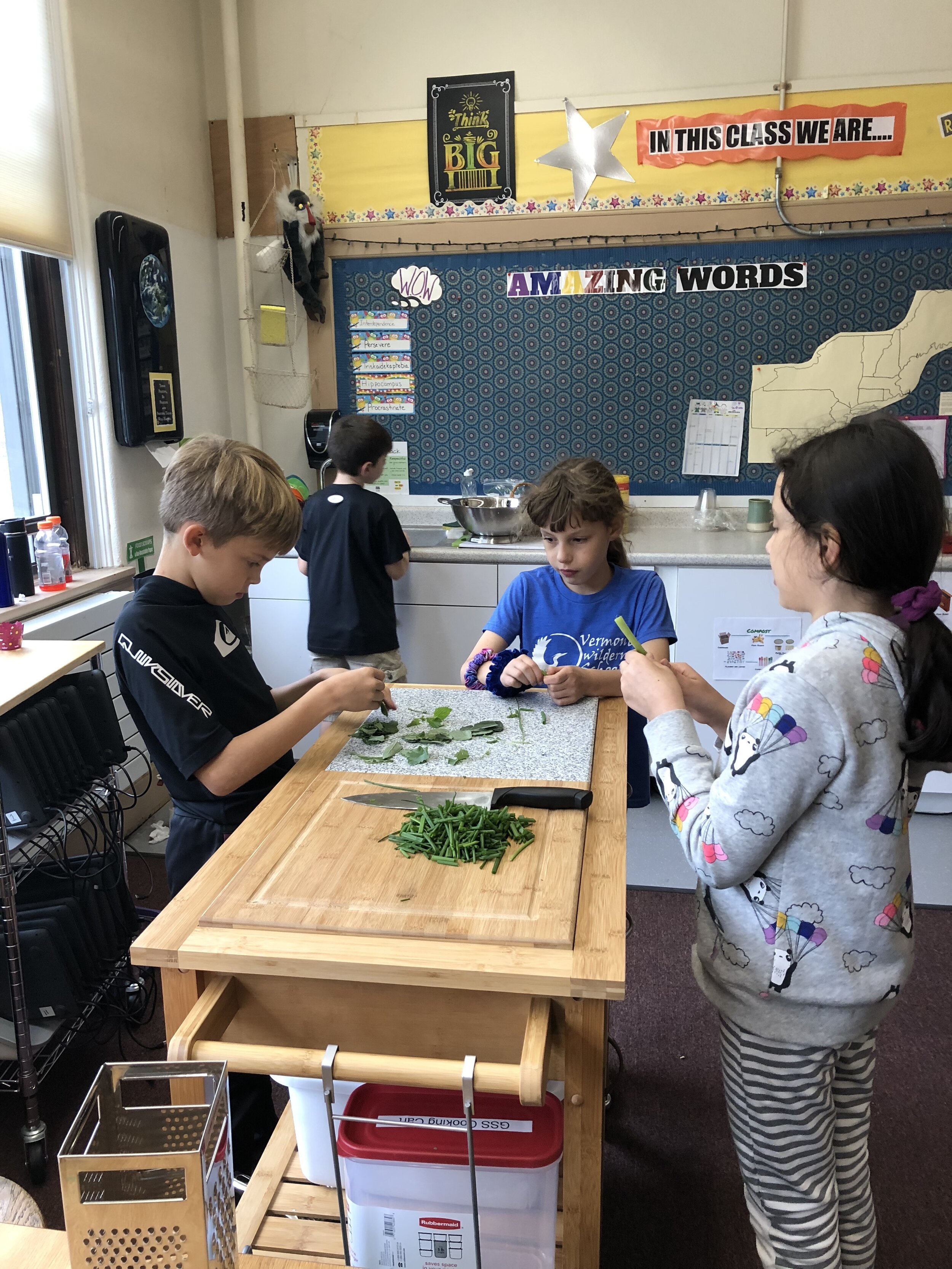
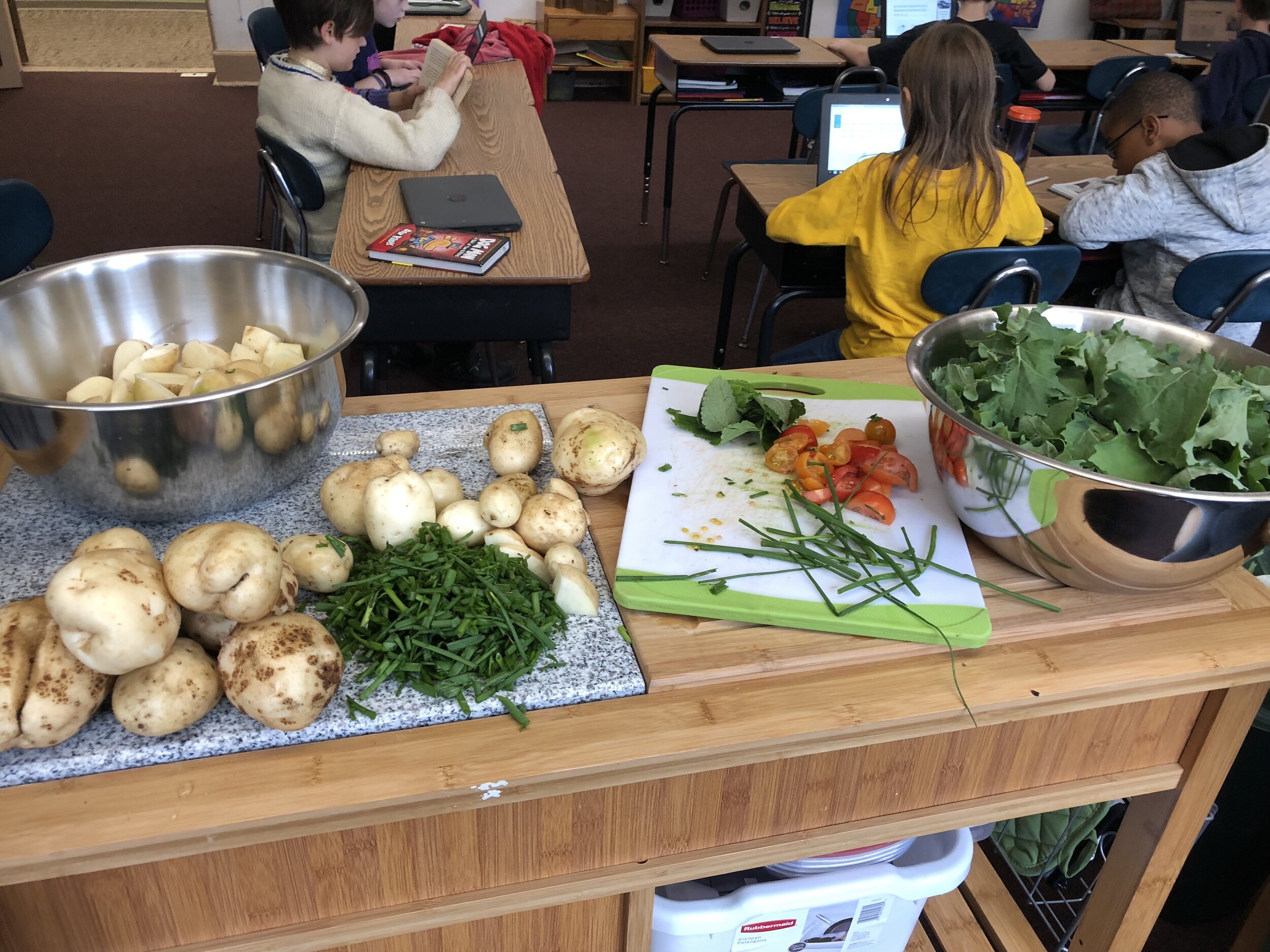
Food Connects supported Green Street School in purchasing and fully outfitting a cooking cart, which is a rolling kitchen island stocked with all the equipment needed to successfully cook with students in the classroom. The cart has a food processor, electric griddle, two-burner hotplate, immersion blender, convection oven, and all the pots, pans, and utensils needed to prepare and sample healthy recipes.
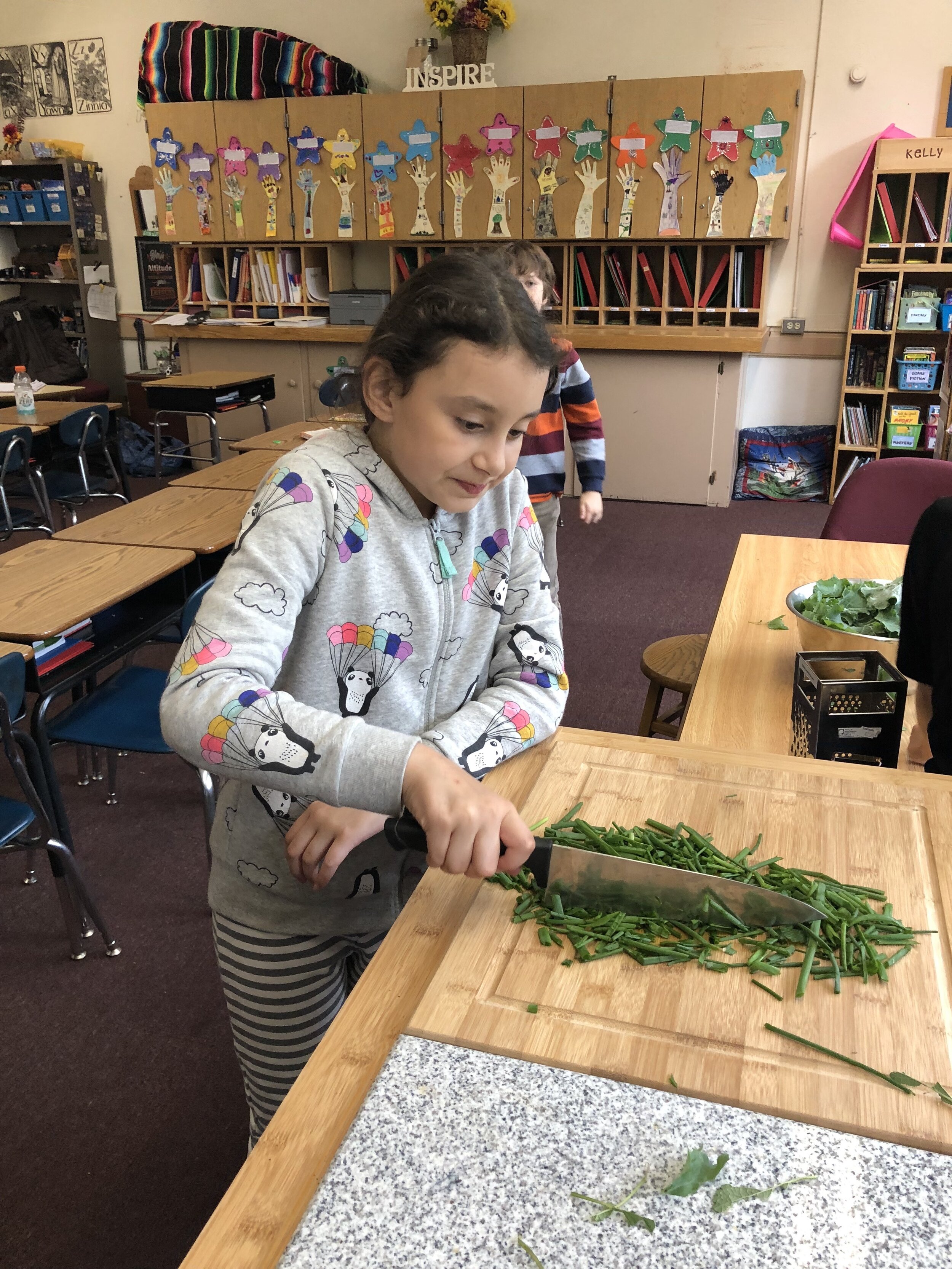
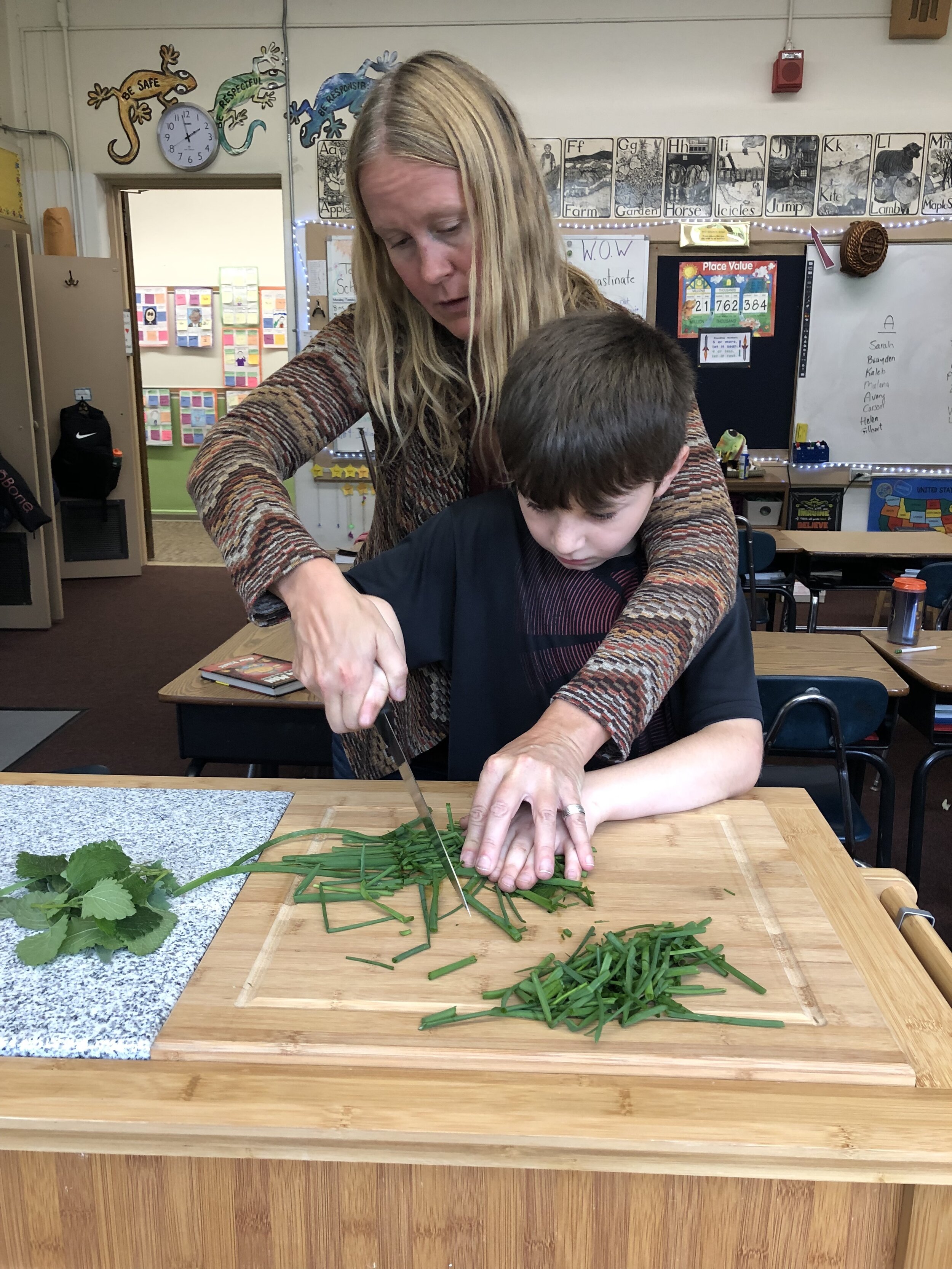
Kelly Shifflette’s 4th graders were the first class to test out the cart, which will be used by all grade levels throughout the year with support from Green Street’s garden coordinator, Tara Gordon. They made a potato kale soup with fresh herbs from the school garden. Ms. Shifflette says that the soup “was delicious and we shared it with the whole staff. Using the cooking cart in my classroom was great and the students learned how to use knives safely.”
What delicious offerings will the students cook up next?

A student and I weigh our options at the new salad bar Harley built over the summer.
Visit any of the cafeterias in the Windham Northeast Supervisory Union and you’ll notice a lot of changes. Last year, Harley Sterling took over as the district’s Food Service Director and transitioned the district to independently operated cafeterias. It’s Harley’s goal to get more local food on the menu, better support his staff, and increase meal quality district-wide.
Earlier this month, we visited Central Elementary in Bellows Falls. Sheila, Food Connects’ Farm to School Program Coordinator, made the trip with me to share a meal and introduce me to Harley. While he was tied-up at another school, we snuck into the line in between 3rd and 2nd grade. We got our trays and headed for the entrees—chicken patties and roasted potatoes. At the salad bar, there was a wide selection of leafy greens, fresh veggies, and protein-packed sides.
With loaded trays, Sheila and I grabbed our seats in the middle of a table and immediately started talking food with our new 3rd grade friends. Owen and a few of his friends shared with us their favorite foods—there were many chicken patty fans. Owen was a strong proponent of Taco Day. Just as we were getting into the finer details of the salad bar, Harley arrived.

Luckily, Sheila remembered to snap a photo of my lunch before I dug in. It looks like I’ll need to work on my presentation during my next lunch photo shoot.
Harley spends most of his time in the Central Elementary cafeteria. As we ate, he explained the balance he’s trying to strike between filling the menu with new, healthier foods and making sure kids still eat lunch. My lunch tray stood as the perfect example: chicken patty may not be the healthiest protein option there is, but it’s a familiar item that most kids like. From there, students can start trying new items at their own pace. My salad was topped with fresh, crisp red peppers and tofu. The Asian rice salad was new to me and delicious as well. Harley and his team have been working hard to build the trust with their students so that participation stays high as they introduce new items in the cafeteria.

Harley and Erica, the School Nutrition Site Manager, holding up a banner Sheila and I dropped off.
And, it looks like it’s working! As we spoke, a girl next to us was eating her way through a small pile of peppers. Harley explained that many foods we may not think of as new or exotic are foreign to some students. “Tacos,” Harley said, “are one of those foods that have required a reintroduction for some students.” At the mention of his favorite lunch, Owen’s eyes lit up and he reminds me that tacos are his favorite.
Before we can dive back into our conversation, it’s time for a quick birthday celebration and then lunch is over—I forgot how short school lunch is!
National Farm to School Month
Food Connects Gives
Foodworks Finds a New Home
Summer Garden Reflection
Green Street School Garden Coordinator, Tara Gordon, spent her summer working for Food Connects to care for school gardens at 5 area elementary schools in the towns of Brattleboro, Guilford, and Vernon. This summer garden program was made possible in part thanks to a grant from Rise Vermont. Here are a few highlights from Tara’s summer in the gardens:

Teachers from Academy School met with Tara in the spring to orient her to the garden and show her some of the crops they were growing. This included popcorn seedlings donated by Wild Carrot Farm that needed to be hand-pollinated. Throughout the summer, Tara connected with families on the playground while she was working in the garden. School staff helped with watering and harvesting. Funding for school gardens and the supplies needed can be difficult, but Tara reached out to the Brattleboro community and they did not disappoint. She was able to get a bale of straw donated for mulching, needed to combat the weeds and help the garden flourish. Teachers and students are looking forward to harvesting from their beautifully tended garden this fall!


Green Street School had families and neighbors who helped in the garden throughout the summer. The harvest was bountiful over the summer and extra produce was shared with school staff and neighbors. Tara was able to process and save some produce for school year classroom activities as well. Green Street has an ongoing relationship with Yalla Vermont growing and harvesting cilantro, parsley, and calendula for the Yalla kitchen. Because of Tara’s and the Green Street School community’s work this project continued throughout the summer. Tara also tended heirloom peas as part of a project in collaboration with the Brattleboro Words Project. These peas are an early variety which was grown in Brattleboro in the late 1700’s, and seeds from this year’s harvest will be available next year through a seed saving project in collaboration with Brooks Memorial Library!


Guilford Central School has well-established gardens and a great core group of active families who came to the garden throughout the summer to garden and harvest with Tara. Surplus produce from the school garden was brought to the Guilford General Store a couple of times and the school garden was highlighted on the General Store’s menu! Guilford Central School’s Farm to School Coordinator, Sarah Rosow, was a great partner for Tara, with many garden systems already in place, including a well organized tool shed and a clear plan for summer planting. In addition to her work in the garden, Tara was also able to process some calendula and basil for Sarah to use this fall with her students.


Oak Grove School invited Tara to work in the garden with some classes in the spring to seed and plant, and learn about weeds. The Brattleboro Town School District summer school was based at Oak Grove this year, which allowed Tara to work with students and teachers regularly in the summer. Neighbors also showed support for the garden—in particular, a nice neighbor just across the street donated a bale of hay for mulch. The bulk of the food grown in Oak Grove’s garden will be harvested by students this fall and each class will cook a dish for the annual harvest dinner in October.


At Vernon Elementary School, the river bed soil is very rich and the plants flourished. The primary goal for the garden in Vernon this year was to provide families a space to grow and harvest over the summer, and crops were planted with summer harvesting in mind. Several families worked with Tara throughout the summer, and extra produce was brought to the Vernon pool to share with the community. Next year, this group hopes to have a Vernon School Garden Booth at their 4th of July town festival.

Community building was an essential of Tara’s work this summer. Tara created Facebook groups for each school garden as a tool to reach parents during the summer, and she made colorful flyers to spread the word about her weekly school garden parties. She also made connections with Edible Brattleboro, a local college student, and several high school students who used community service hours to help her tend these gardens. Many hands made the work a little lighter!

It was incredibly helpful to the schools to have someone care for their gardens and build community in the gardens over the summer, and Food Connects is pleased that we were able to offer this program for the third year in a row. Many thanks to Tara for her hard work tending gardens and building summer garden communities at each school, and a big thank you to Rise Vermont for helping to fund this important and valuable work!
Photos By: Tara Gordon
Foodworks, the Groundworks-run community resource in Brattleboro, has increased its storage capacity while also transforming the shopping experience at their new Canal Street location where shoppers are invited to pick up the food they need for free. We had the opportunity to visit the location last month to participate in a trauma and food-focused community of practice with a group of Groundworks staff. The group was formed as a result of the Food and Trauma Training Food Connects put on last spring, in collaboration with Equity Solutions, and their takeaways from the training are present throughout the new community resource.

Upon arriving that morning, we stepped into the waiting room. Natural light streamed through the floor-to-ceiling windows, creating an inviting space for shoppers to hang out until it’s their turn. After checking in at the reception desk, shoppers can grab a cart or basket and walk the isles of food. Clear signage guides shoppers throughout the experience and indicates which items are limited, making it easy for first-time shoppers to feel right at home.

Shortly after we arrived, Ava, the Foodworks assistant, pulled around back with a delivery of frozen meats, fresh produce, and cakes. We were happy to lend a hand unloading the truck while we learned more about the decisions that went into creating a sensitive and welcoming space. Food placement is one area where some changes accompanied the move. While the desserts used to be located at the entrance, which are limited to one per household per month, weekly fresh produce now greet shoppers entering the store—items that are available to everyone and a healthy staple. “We tried to organize the space so that weekly items are the most easily accessible and monthly items are somewhat hidden,” Christine, the Foodworks coordinator, said. “Now, weekly shoppers don't have to feel bad walking past items they can't access.”

The registration process was streamlined and it’s now easy to get in and get the food community members need. A staff member is always at the registration desk, ensuring that shoppers can count on a familiar face to greet them when they enter. “Changing [registration] from a volunteer role to a staff-only role is one of the biggest changes we made in an attempt to be more trauma-informed.” Christine said, “Having this be a staff-only role has allowed much more consistency, familiarity, and comfort for patrons.” At check-out, another staff member or volunteer helps shoppers bag their food and answer any questions they may have.
It's these little changes that the Foodworks staff have found make a big difference when welcoming the community. Being upfront about expectations at registration and explaining the rationale behind the rules has led to a common understanding. Altering their hours so that donation pick-ups could be finished by the time Foodworks opens means that shoppers can rely on a more consistent experience and food selection each time they visit.

Overall, Christine has received mainly positive feedback. Shoppers have credited the waiting room, improved lighting, improved parking, and increased space as big improvements that have led to an experience more akin to your typical grocery store.
Get involved
Along with comfy chairs and a little library, the waiting room has space for food demos and tastings. Foodworks is looking for volunteers to put on demos highlighting the produce available on the shelves and also be a source of knowledge for shoppers looking for cooking advice. Christine also noted that food donations are low this time of year and welcomes shelf stable items as well as garden produce.
You don’t need to be experiencing homelessness to shop at Foodworks. Swing by during their open hours and talk to a staff member to learn more about how you can access this community resource. Foodworks is proud to serve the entire community and understands that sometimes folks need a lot of food assistance, and sometimes shoppers just need help with items like produce and bread which are often prohibitively expensive at the grocery store. With all these changes, their goal has been to eliminate stigma about accessing Foodworks.
Foodworks is located at 141 Canal Street and can be reached by phone at (802) 490-2412.
Their hours are:
Monday 11-4
Tuesday Seniors 12-2, Everyone 2-4
Wednesday 1-6
Friday 12-4
Last Saturday of each month 9-12

Meet Our New Farm to School Program Manager
Leland & Gray’s New Look
Farm to School Celebration
Trauma & Nutrition Training
Voices of the Food Chain
NH Farm to School
In late August, Food Connects hosted a Trauma and Nutrition training for 31 Windham Southeast School District (WSESD) wellness leaders, including school nurses, counselors, behavior specialists, and food service directors. This training, funded by a grant from the Thompson Trust, educated wellness leaders on the connection between trauma and nutrition with the expectation that participants bring the information back to their school communities.
Professional development for schools focused on trauma and resilience is increasing. Schools that are more trauma-sensitive increase the chances of all students to succeed. On the heels of WSESD’s trauma-informed training for educators earlier this summer, Food Connects hosted their training specifically for school wellness leaders. Food and trauma are uniquely intertwined—food traditions can establish a strong sense of community but food can also be a point of stress and anxiety, especially in a loud and overwhelming cafeteria environment, and for students experiencing food insecurity at home. A central question participants were asked to consider when making choices about how students interact with food was “how do we raise awareness about food and trauma and how do we understand how our actions impact others so that we aren’t unintentionally creating stress for our students?”

Joelle van Lent, a licensed psychologist, and Sheila Humphreys, Food Connects Farm to School Coordinator, led the training. The group of school professionals listened with eager ears to their words—learning the foundations of trauma and how to create trauma-sensitive environments. The group took time to consider their implicit biases around food by recording their initial reactions to images food like salads, Cheetos, and chocolate cake. This activity dug into how being trauma sensitive includes being neutral and curious as opposed to judgemental. “I think this was the most impactful part of the day,” said Ali West, Food Service Director for the Brattleboro Town Schools. “It was insightful to see that while I thought YUCK at the boxed macaroni and cheese others felt nostalgic towards it. It reminded me of what one third grader said to me when he asked for ketchup for his toast and I went YUCK, and his response was ‘Don't yuck my yum.’ This has become a mantra of mine whenever I work in one of my cafeterias.”
Another focal point was to exemplify that we, as adults, make assumptions about how students view school food based on our personal experience. The group read aloud quotations from Vermont students about their cafeteria experiences—“No snacks at home equals no snacks at school. I just pretended I didn’t want one.” “It is noticeable that I receive free lunch.” “Too many people crammed in one place. I will probably just not eat.” It is clear that cafeteria spaces are not always safe spaces for all students. “Kids might not know if food will be present at home. This creates a traumatic association with food that can carry over to the cafeteria,” says Joelle. “The question becomes, how can we make getting food easy, calm, and predictable for all students?”

As part of the training, school wellness leaders were asked to create action plans for the school year focused on improving school meals and farm and food education through a trauma sensitive lens. Goals created by wellness teams included:
Train all school staff on the material presented
Change school culture regarding the use of food as a reward
Increase staff awareness about implicit bias regarding foods students eat at home
Teach social skills during lunch
Decrease the chaos at lunchtime
Have staff sit with students at lunchtime in the cafeteria
Food Connects will provide ongoing coaching and support to wellness teams throughout the school year to make progress on these goals, which will help to create a healthy school food culture for all students in WSESD schools. By strengthening the school community and making school meals feel calm, predictable, and a place for positive connections with peers and staff, schools can play an important role in preventing the development of eating disorders and lifelong struggles with food for our students. Co-facilitator Sheila Humphreys says, “I am looking forward to coaching wellness leaders as they work together to create strong school communities to support our most vulnerable students, because research shows that children can withstand a considerable amount of adversity when they are connected to a strong community and have predictable calm routines.”
This training was immensely impactful. In the training pre-assessment 65% of the participants reported that they had an understanding of the connection between trauma and nutrition but no participants felt that their knowledge was strong enough to teach the material to others. “I really took so much away from the training,” said West, “at first I was completely overwhelmed and thought ‘what on earth am I doing here. This is all behavior stuff not food and then it all clicked and I realized yup, glad I'm here.’” In the post assessment, there was a 70% increase in the number of participants who felt like they could train others on the material. The ability to bring this information back to schools to share with their colleagues empowers wellness leaders to critically look at their programs and enact change.
“My experience with the Trauma and Nutrition Training was very useful,” said Jody Mattulke, Family Engagement & Education Coordinator at Academy School. “Trauma and the infinite connections and associations with food fostered greater awareness of how students may struggle. Students may struggle with memories stimulated by olfactory senses, have strong emotions evoked by inconsistencies in quality and availability of food and lack the skills to navigate these emotions as well as have difficulty with social settings and the systems around food in the schools. The module on resiliency was invaluable—relationships are the great protective factors to support students as they improve their confidence & competency to feel they belong in the community.”

In the words of participant Matt Bristol, Physical Education Teacher and Athletic Director for the Putney Central School, "My big takeaway was learning suggested practices and policies to put in place school wide to ensure food security and a positive culture around food.” Schools are uniquely positioned to improve and change students’ experiences with food. Taking these skills back to the schools is essential for creating trauma-sensitive spaces. Students need a place where curiosity and acceptance are the standard, leaving judgement at the door.
In other words, “Don’t yuck my yum.”