On February 10, students at Brattleboro Union High School discovered that carrots have a lot to teach us about taste, plant biology, food storage, and osmosis.
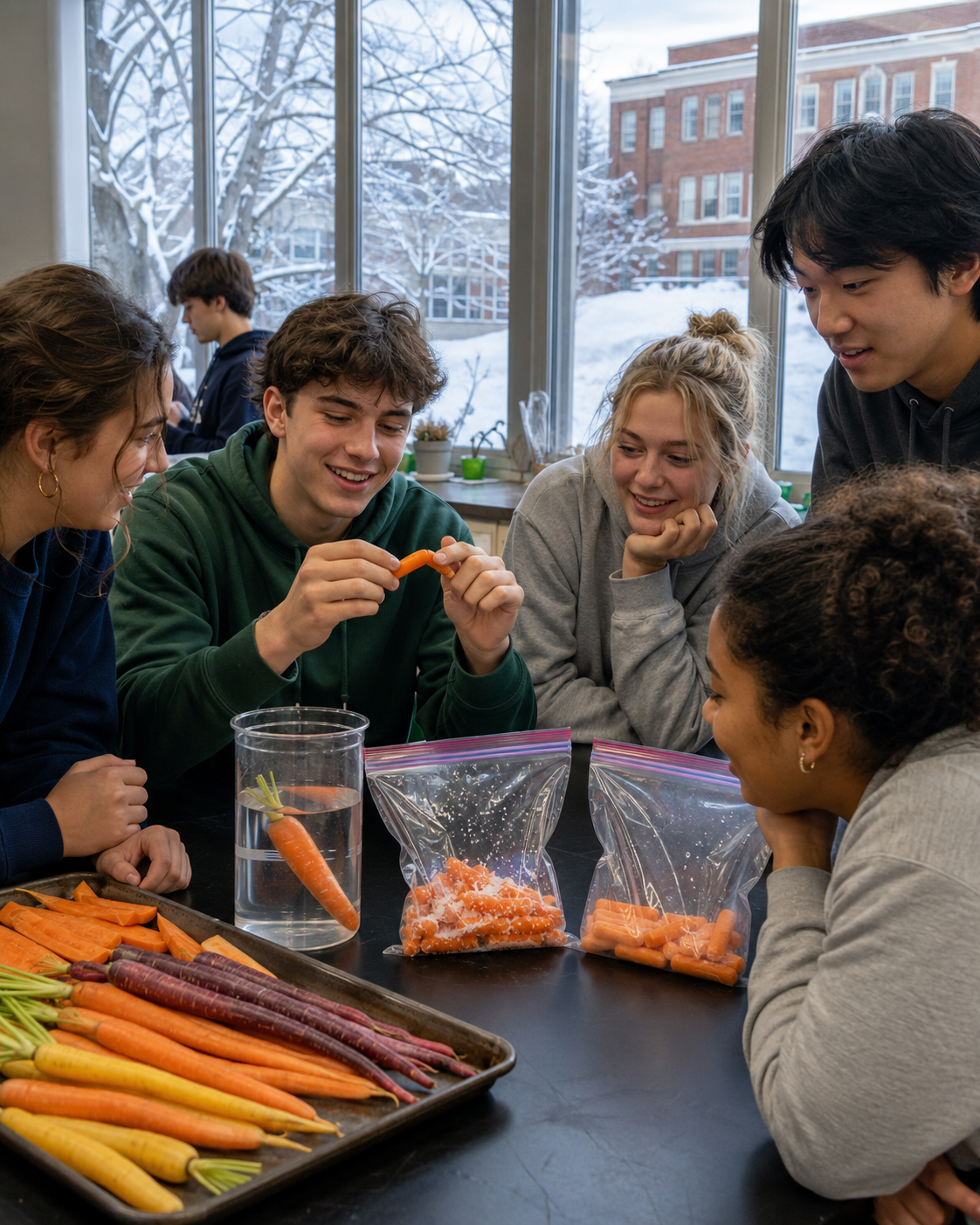
Farm Club students began by exploring carrots through a taste test. After recording their hypotheses, they sampled carrots of different colors to determine whether color affected flavor. The group did not notice a significant difference, although some people describe purple carrots as sweeter than orange carrots and yellow carrots as less sweet.
Students also learned that some of the earliest cultivated carrots were purple, rather than the familiar orange varieties most common today.
In the Science of Food class, carrots became tools for studying osmosis, the movement of water across cell membranes. Students first considered a familiar question: Why does a carrot become limp after sitting in the refrigerator for too long?
The answer is dehydration. Carrots are roots that absorb water from their surroundings. When placed in water, their cells rehydrate and regain the firm, satisfying crunch of a fresh carrot.
Students then tested what happens when water is drawn out of a carrot. They placed a baby carrot and salt into a resealable plastic bag and shook it for five minutes. For comparison, they placed another carrot in a bag without salt to serve as a control.
Water soon began collecting inside the bag containing salt. Students correctly identified that the salt was drawing water out of the carrot. As the carrot lost moisture, it became flexible enough to bend by hand. The carrots in the control bag remained firm and snapped when bent.
The final lesson focused on the carrot’s impressive storage abilities. Students looked into the snow-covered school courtyard and saw plenty of white and gray, but nothing growing that was bright orange. Yet the class was using carrots grown on a Vermont farm.
Carrots harvested in the fall can remain fresh throughout the winter when stored under the right conditions. This makes them an important regional storage crop and a dependable ingredient for winter stews, slaws, and school meals.
With the help of local carrots, BUHS students discovered that food is full of fascinating science. Farm Club and Science of Food are proving that meaningful lessons can begin with everyday materials, including a carrot, a plastic bag, and a little salt.
- Farm to School Coach, Adelaide Petrov-Yoo