
Our Farm to School Program Manager, Conor Floyd, joined Peter ‘Fish’ Case on Call to Action to discuss how Food Connects and schools are partnering to feed students during the uncertain times of COVID-19. Listen now!
Exploring Equity at Food Connects
What is the intersection between trauma, equity, and nutrition in our food system? This is a question that the Food Connects’ Equity Team grapples at each of our team meetings. This investigation allows us to take a critical look at the work we are doing in our community and engages us in deeper conversations around race, gender, and socio-economic status.
These conversations may seem daunting to some, but luckily there is a great resource to guide us through these challenging conversations. Last year, for the first and certainly not the last time, I participated in Food Systems New England’s 21-Day Racial Equity Challenge. The challenge consists of a daily email with information and prompts that encourage participants to learn, reflect, act, and go deeper on topics of racial justice and equity in our food system. The readings, videos, podcasts, and discussion questions gave me tools and resources that I returned to throughout the year as I wrote about the importance of working towards greater equity in our food system.
Last year, more than 3,500 people participated in the challenge. This year, in addition to individuals, they are opening the challenge up to whole organizations. So far more than 500 organizations signed up. The challenge runs from March 30 to April 19, and I encourage you to sign up personally or for your organization by clicking here.
Something that stuck with me the most from last year's challenge was the theme of storytelling. I have often referenced the Voices from the Food Chain videos this year, and I gave a lot of thought to how we, at Food Connects, can amplify the voices of the people we serve, including food service workers in our school cafeterias and students in our community who are coping with food insecurity.
We formed an equity team at Food Connects last summer, and we’re engaging in conversations about how to bring greater equity to our work with farmers who are people of color, women, and/or members of the LGBTQIA community.
I am looking forward to another opportunity to think about my work from different perspectives and to continue to ask myself how together we can build a food system that provides dignity for everyone. I hope that you’ll join me!
By Sheila Humphreys, Farm to School Coordinator
April 2020 Farm To School Newsletter

Farm to School Responds to COVID-19
WSESU Schools Respond to COVID-19
Area Schools Provide Free Lunch
Professional Development
Racial Equity Challenge
Windham Southeast Supervisory Union's Meal Program Response to COVID-19
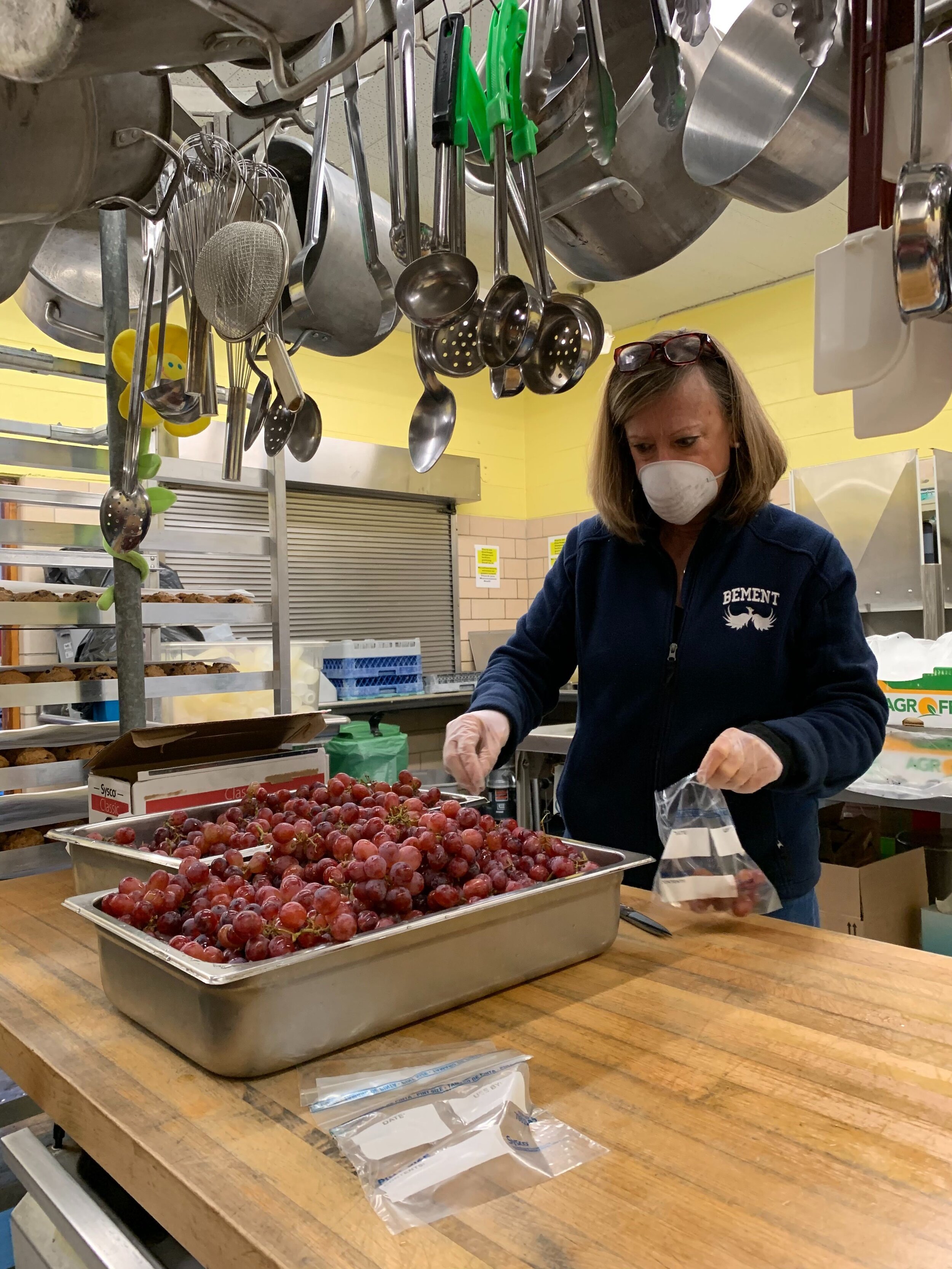
Alison Kelly, Intensive Services teacher at Brattleboro Union High School & Brattleboro Area Middle School, volunteers in the Academy School Kitchen portioning out fresh grapes for student lunches.
When Food Service Directors Ali West and Justin McArdle of Fresh Picks Cafe received the call that schools in Windham Southeast Supervisory Union (WSESU) would be canceled due to COVID-19, they stepped into high gear, figuring out how to quickly get school meals out to students throughout the region who depend on those meals.
Initially, there were administrative hurdles to jump through in order to receive funding for these meals through federal and state funding sources. Kira Sawyer-Hartigan, WSESU’s Nutrition Programs and Wellness Consultant, assisted Ali and Justin with navigating these issues. Once they received the go-ahead from federal and state agencies, Ali and Justin rolled up their sleeves and got to work, doing what they do best—feeding children.
Ali, Justin, and staff from their own kitchens, as well as staff from Vernon, Guilford, and Dummerston now work together in two kitchens (Academy School and BUHS/BAMS) to make breakfast and lunch daily for nearly 1100 students in WSESU. School buses are used to help with distribution with teachers and paraeducators volunteering to ride along on the bus routes and hand out the food to families. This support from school staff is crucial—it brings a friendly, familiar face to these vulnerable families during this challenging time. BAMS/BUHS intensive services teacher Alison Kelly says that she has volunteered on the Vernon bus regularly as a way to stay connected with some of her students, and she has witnessed first hand the smiles on students' faces as they come to meet the bus each day to receive their food. Her students look forward to this friendly routine each day. Right now, the meals served are cold breakfast and lunch, 5 days a week, but as the new system grows and funds allow, Ali and Justin would like to add some hot meals to the menu, as well as dinner and food for the weekends.
A Glimpse at Academy School’s School Meal Operation
Ali starts each day in her kitchen at 5 am, checking the master list of students who are signed up for meals and making new additions to that list daily as more requests come in. She also works closely with Becca Kenyon, the dispatcher at Kuzmeskus bus company, to figure out how to reconfigure bus routes to accommodate new families who sign on to the meal program. Ali says she couldn’t do this work without Becca—Becca is so devoted to the project that she works some nights and weekends, driving around to figure out how to seamlessly fit in new stops to the routes so that all families can participate easily.
By 6:30 am, Ali’s crew arrives and starts to work. They assemble bag breakfasts together like a well-oiled machine. They had some practice with assembly-line meals prior to COVID-19—they were already preparing 300 bagged after school meals daily. Now, the existing systems are expanded to make everything work on a larger scale. There are no students in the building, allowing the staff to spread out rows of bags across several tables in the cafeteria, and this added space is crucial to the operation.

Ali says one challenge faced by her staff is having chronically dry hands from near-constant washing and sanitizing. She says her staff is very conscientious of all safety protocols including vigilant hand sanitation, wearing masks and gloves, and keeping 6-foot distance. Wearing masks is so natural now that every day someone forgets they are wearing a mask and tries to take a sip of coffee or a bite of lunch without first removing the mask, which can be messy! Luckily, they have plenty of colorful masks handmade by volunteers, and Ali jokingly says that wearing masks has the added benefit of stopping stress-eating at work!
Ali is challenged by product shortages of certain items like single-serve yogurt containers and individually packaged cheese sticks—which are in high demand by schools all across the country. Whenever possible, Ali tries to keep the menu consistent because she knows how a last-minute menu change can be challenging for students. Ali continues to face the ongoing hurdle of tight budgets for the meal program. Luckily, she was able to find a creative way to save 23 cents per bag by leaving out condiments and plastic utensils since students are eating these meals at home—freeing up resources to improve the quality of the food she serves.
By far, the coordination of all the moving pieces of this new feeding program is the biggest challenge for Ali—from managing staff and volunteers to figuring out correct quantities in order to minimize food waste. She likens the work that she has done creating new systems in uncharted territory as being an “air traffic controller with my eyes closed and working in a different language.” But, she is finding her stride and providing critical leadership to make the program run smoothly. A colleague recently expressed the need to wrap Ali up in a highly sanitized bubble to protect her from all illness, because the school district is relying heavily on her right now to keep the operation going.
Ali’s dedication to feeding our community runs in the family. Her mom runs the Guilford Food Pantry—which remains open during the pandemic and is offering curbside delivery with the help of Ali’s father, also working as a volunteer. Families write their orders on an order slip and Ali’s parents bring orders to volunteers working inside the pantry who pack boxes of food. Ali is concerned that her parents stay healthy, and so she donated oodles of pencils to the food pantry so that each person can keep the pencil they used to place the order.
A Glimpse at BUHS’s School Meal Operation
At Brattleboro Union High School, the staff transitioned quickly after Governor Scott ordered schools to close. “The very first thing we did was to sanitize everything,” said Justin McArdle, BUHS Food Service Director, “we’re pretty meticulous about cleanliness and sanitation regardless, but when we realized the magnitude of this thing, we ramped it up to 11.” After they did a deep clean, the team began thinking about what changes needed to happen. They tried adapting as much leftover food in the kitchens into deliverable meals and created a new menu that enabled easy distribution.
The biggest change was transitioning from primarily serving hot meals to entirely cold meals. “The process has changed significantly,” said Justin. “We’re now doing volume production, instead of making 18 pizzas a day and 200 sandwiches and a few batches of a hot meal, we have people prepping out 400 salads and 400 cups of yogurt, there’s an assembly line feel to it right now.” From a chef’s perspective, Justin would like to see more scratch cooking, but he sees the current set-up as the most effective way to serve the entire district—which is putting out over 2100 meals per day—during this time of need.

Justin also says that the entire staff has stepped up to the challenge. Like everyone else in the community, the staff are concerned about their health and the wellbeing of their families. But they still come in every day and have adapted to the change really well. “I really admire how they have managed to come in and grasp it so quickly,” Justin said during our interview.
There have been some hiccups along the way. Supply chain disruptions are still occurring. “Last week it was finding paper bags,” said Justin, “this week it’s been finding cheese sticks.” The entire staff has to be resourceful in finding alternatives when shortages occur. The community also pitched in. Recently, Food Connects put out the call for community members to lend their coolers to the program to help distribute the weight of all the meals being delivered. Within a couple of days, Justin had the ten coolers he needed.
When asked how the community can help now, Justin said that more families could sign up for school meals and help spread the word to their neighbors and friends. The program is free to all children 18 years and younger. The district asks that families fill out a short survey to help the program better predict the number of meals they need to make. More information about the program can be found on their website.
Farm to School Responds to COVID-19
It’s been a crazy past couple of weeks. It’s hard to imagine that only two months ago Coronavirus was a headline from halfway across the world for most of us in New England. Now, schools are remote learning, businesses are closed down, and everyone is adjusting to a new way of life. These changes deeply impacted Food Connects as we adjusted our operations and shifted our focus to the community response to the COVID-19 outbreak.
Food Hub

Since mid-March, Food Connects closed its office to everyone except essential employees. Who’s an essential employee at Food Connects? Our drivers and operations staff that play a vital role in maintaining the local food supply chain. They continue working under heightened safety protocols to ensure that schools, co-ops, hospitals, and communities continue to have access to local, healthy food. As we adjust to this new way of life, our entire staff is reminded of how vital our work is.
Thanks to our already strong safety protocols, connections with producers and consumers, and our dedicated Food Hub team, operations continue throughout this period of transition relatively unimpeded. Old programs, like community-based buying clubs, gained traction once again as shoppers re-discover the importance of local, source-identified food.
Farm to School
The Farm to School team is working remotely during this period as well. Like the Food Hub, Sheila and Conor are utilizing their strong connections with teachers and partner organizations to coordinate a response to the growing nutritional needs of our community. Food Connects’ Communities of Practice continue to deepen the interconnected relationships of anti-hunger champions throughout Windham County, aiding in the quick response and collaboration of schools, food shelves, and other community organizations when schools were mandated to close.

We took the lead in coordinating between school districts and the Windham Region Hunger Council. In this role, Food Connects has ensured the clear flow of information and resources between schools and partner organizations, the VT Foodbank, and area food shelves. We can see these channels of communication in action, quickly fulfilling the volunteer needs of schools as they arise. With the Hunger Council, we also maintain an updated database of each district's school meal program during the school closure and concisely disseminate that information county-wide via local news media.

Working directly with schools, we continue to support Food Service Directors by aiding in the spread of information, finding answers to rules and regulations, and coordinating volunteers for their programs. As teachers begin to settle into their new routines, we will be another layer of support for them by sharing resources and facilitating online Communities of Practice and Farm to School committee meetings. This is especially important as we collectively navigate the next stage of questions—how do we engage students in farm to school while teaching remotely, what will the school’s garden program look like for next year, how do we maintain the progress we’ve made this school year?
Everyone at Food Connects is working to strike a balance between meeting our community’s immediate needs and not losing sight of the future. School gardens, nutrition education, and local foods are all mentally and physically nourishing activities that will be in high demand once this is all over. We’re excited to help our partners and schools be prepared for when that time comes.
Food Connects Expands Professional Development Offerings
Food Connects Farm to School program is excited to step into new roles of leadership in the Windham Region and at the statewide level through expanded professional development opportunities. Interest continues to grow for workshops exploring Farm to School’s role in supporting students through a trauma-informed approach. Food Connects was awarded an Agency of Education contract, along with our partners from across the state, to provide additional professional development in the coming school year.
Trauma and Nutrition Professional Development

Food Connects began our second year of a two-year grant from the Thomas Thompson Trust focused on investigating the links between trauma and nutrition. We’re grateful for the opportunity to develop a set of best practices and resources for schools that utilize Farm to School approaches to support students through a trauma-sensitive lens. We now provide professional development opportunities on this topic and the interest in our trainings is very high. We are also coordinating a bi-monthly community of practice group on this topic for wellness leaders in WSESU, and participants find those discussions rich and valuable. As we continue to monitor and respond to the COVID-19 crisis in our community, we know that resources for supporting students who experienced the trauma of food insecurity are becoming more and more relevant every day. We deeply appreciate the support we have received to delve into this important topic and share our learning throughout the region. If you are interested in learning more about this work, please contact our Farm to School team at farmtoschool@foodconnects.org.
Agency of Education Contract
In early March, the Agency of Education awarded Food Connects and other regional Farm to School organizations a contract to provide professional development to educators across Vermont over the next year.
As a part of Vermont Farm to School Network, Food Connects works with the Ease of Use team to better reach Farm to School coordinators across the state. The team hosts regional gatherings, collaborates on professional development opportunities, and publishes a quarterly newsletter. This past winter, the Agency of Education released a request for proposals for contracts to provide Farm to School professional development throughout Vermont. The Ease of Use team was well-positioned to serve out this contract given its collective experience delivering Farm to School professional development and the combined geographic reach of the organizations.
Through the collaborative contract, Food Connects, Green Mountain Farm-to-School, Healthy Roots Collaborative, VT FEED, and Vital Communities will create a unified set of modular professional development workshops. These workshops may include topics such as collaborating with farmers, the school nutrition program as a curricular resource, and trauma-informed approaches to nutrition education. Each regional organization will bring this newly created catalog of workshops to school nutrition professionals and teachers in their area to identify which workshops should be offered. This approach ensures that there is a consistent Farm to School approach throughout the state while still providing regional flexibility.
Food Connects is excited to be a part of this partnership which highlights the highly collaborative nature of the Vermont Farm to School Network. We look forward to sharing our knowledge of Farm to School programming and nutrition education with our statewide partners and bringing new professional development opportunities back to our stakeholders in southeastern Vermont.
Area Schools Provide Free Lunch to All Children
School nutrition programs in Windham and Windsor counties responded quickly to the state-mandated closure of all schools. Districts in both counties have created an alternate delivery model for school meals, utilizing a combination of school- and community-based distribution sites and bus delivery routes.
The following districts are providing free breakfast and lunch to all children ages 18 or under in their community, regardless of enrollment or free and reduced meals status. No paperwork or identification is necessary and children do not need to be present to receive their meals. Districts request that participating families provide the number of children to ensure enough meals are prepared.
Windham Southeast Supervisory Union: Sign-up Form
Windham Southwest Supervisory Union: Informational Flyer
West River Education District: Sign-up Form
Windham Northeast Supervisory Union: Sign-up Form
Springfield School District: Informational Flyer, call (802-885-5133) with meal orders
Families are encouraged to reach out directly to their schools for additional information or questions regarding meal distribution.
The Hunger Council of the Windham Region is coordinating a community response to the COVID-19 outbreak in partnership with the VT Foodbank and area food shelves. The Hunger Council encourages community members interested in volunteering and organizations with developing needs to utilize United Way’s Get Connected platform. Those looking for additional information or resources should call 2-1-1. For more information on the work the Windham County Hunger Council is doing, contact Margaret Atkinson at margaret@winstonprouty.org.
March 2020 Farm To School Newsletter

Universal Breakfast in Brattleboro Schools
Cafeterias Unknown: Talking Trash with the Leland & Gray Environmental Action Force
Twin Valley Junior Iron Chef: Engaging middle and high school students in cooking and nutrition
Universal Breakfast in Brattleboro Schools
It’s 5:30 am, and Brattleboro Town Food Service Director, Ali West, and her kitchen manager, Linda Griffin, are already hard at work preparing to feed a nourishing breakfast to more than 550 local children in the three Brattleboro Town elementary schools.
Green Street School was the first school in the district to offer Breakfast After the Bell, and it is a wildly successful program, with the highest breakfast participation rates in Windham County last year. This year, Academy and Oak Grove Schools decided to follow Green Street’s lead, which created a welcome challenge to Ali West, who is fiercely dedicated to feeding children in our schools. Breakfast After the Bell builds time to eat breakfast into the school day eliminating the difficult decision students are otherwise faced with—do I play outside with friends or fuel up before the start of the school day? It’s widely promoted as a way to increase breakfast participation rates—and Oak Grove and Academy are excellent case studies.
School breakfast participation rates
January 2019 vs January 2020
Academy School 45.6% 84.4%
Green Street School 78.7% 84.8%
Oak Grove 52.5% 83.1%
The breakfasts are all prepared at the Academy School kitchen, which serves as a central kitchen for the three schools. Ali and her staff developed systems to enable this morning ritual to run like a well-oiled machine, and a few months ago she invited us in to see just what goes into prepping breakfast every day.
In addition to waking up early to get things going, breakfast prep actually begins the afternoon before when all components of the breakfast are assembled. Then, before sunrise, final preparations go into full swing, the positive energy of three strong women (Linda is joined in the kitchen every morning by Lucia Hawkins and Jazzy Nightingale) working together as a team to feed the children while chatting, laughing, listening to the radio, and answering trivia questions.
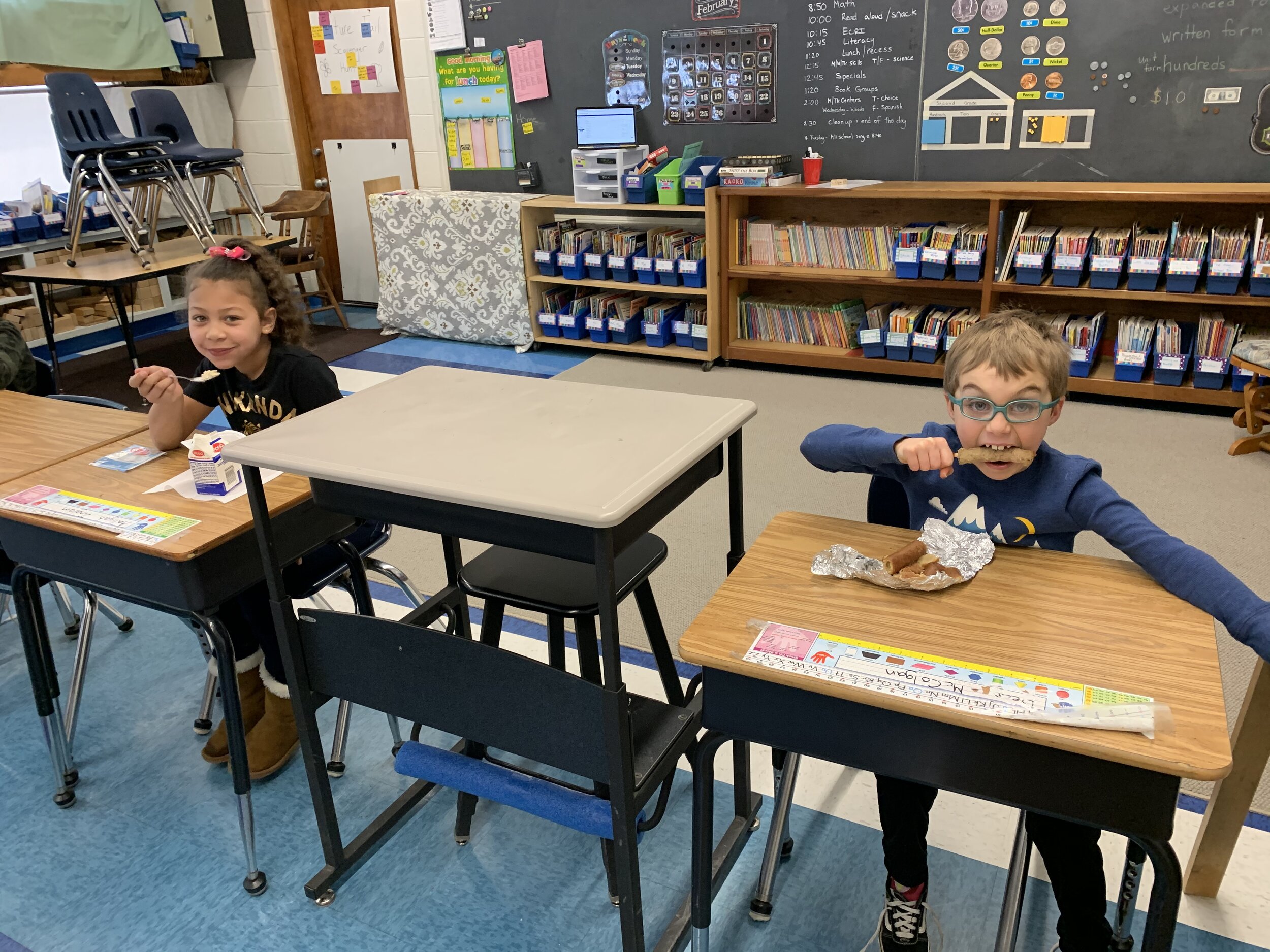
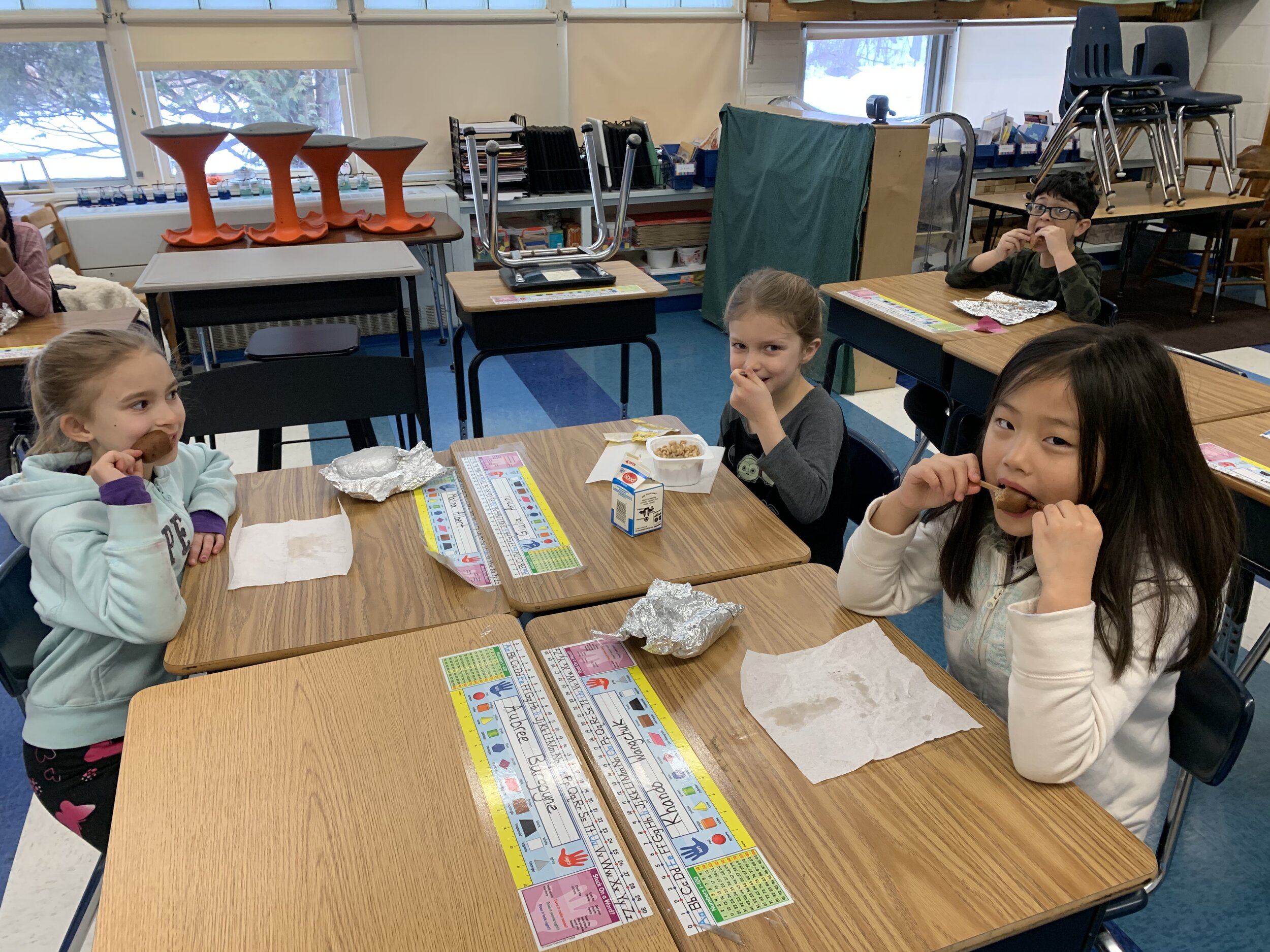
Each classroom receives a bag packed with student’s orders, which might include breakfast sandwiches, bagels, homemade muffins, or the ever-popular option for picky eaters: cereal and milk. Each breakfast also comes with fruit or juice. Bags are delivered to classrooms as students arrive, and teachers have developed creative ways to successfully incorporate breakfast into their morning classroom routines. From Lauren Reavey’s 1st grade class whose “student breakfast helper” fills out the paperwork to Eugene Frost, facilities manager of Green Street, who delivers each bag to the classrooms before the students arrive—all staff and faculty take some part of making this a thriving success for our students.
“Knowing that I’m feeding children who might not otherwise get a healthy breakfast helps me start the day out right,” says Linda. “It’s important that our students receive the nourishment they need to be successful in the classroom, and I’m proud to be a part of universal breakfast in Brattleboro.”
Twin Valley Junior Iron Chef: Engaging middle and high school students in cooking and nutrition
Twelve teams packing into the Twin Valley Middle High School auditorium. Stations getting prepped for the competition to begin. Students and coaches crisscrossing throughout the room as they gather their final supplies. Sixth through twelfth graders with a meticulous eye for the tidiness of their station and a focus on the cooking ahead. As I stepped through the doors of the auditorium minutes ahead of the 2020 Cook-Off, it was clear that for the students, coaches, and parents involved in the program, the real work started months ago.
Junior Iron Chef VT is a culinary competition challenging middle and high school teams to develop their own recipes and perfect their dishes. The competition weaves culinary life skills, health and nutrition education, and teamwork together as students strive to make nutritious, local meals that inspire school nutrition programs. The statewide competition is held in March each year in the Burlington area. Teams from 70 schools will attend the competition and vie for first place in a variety of categories. The Twin Valley Middle High School (TVMHS) stands out from most schools as having a highly competitive and popular program, thanks in large part to Lonny Paige, the district’s Food Service Director. Over the past decade, Lonny built up the program and this was his last year coordinating the event. Due to the popularity of the program at TVMHS, the school holds a qualifying competition (the Cook-Off) in which it selects the top teams to represent the school at the statewide level.
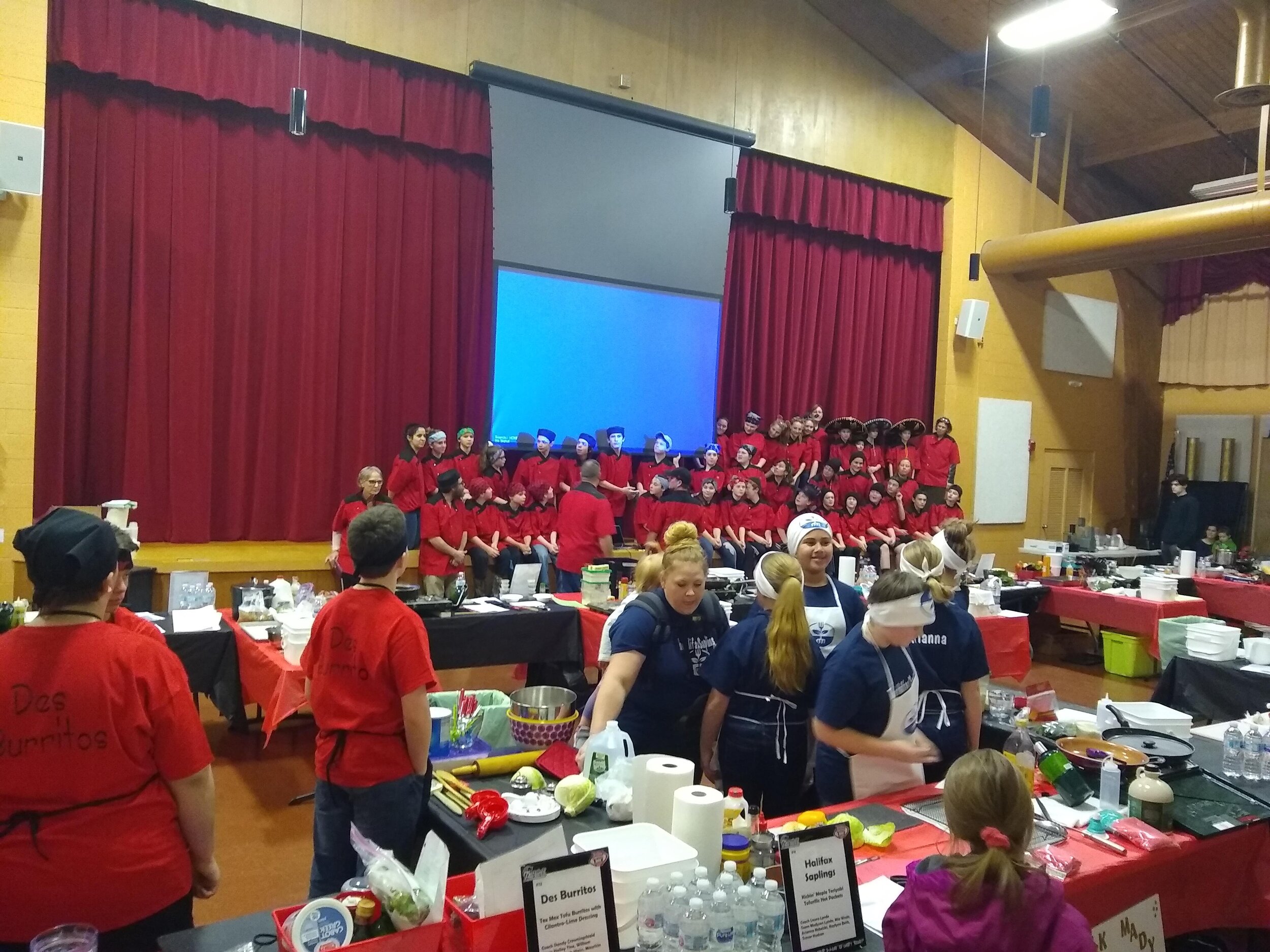
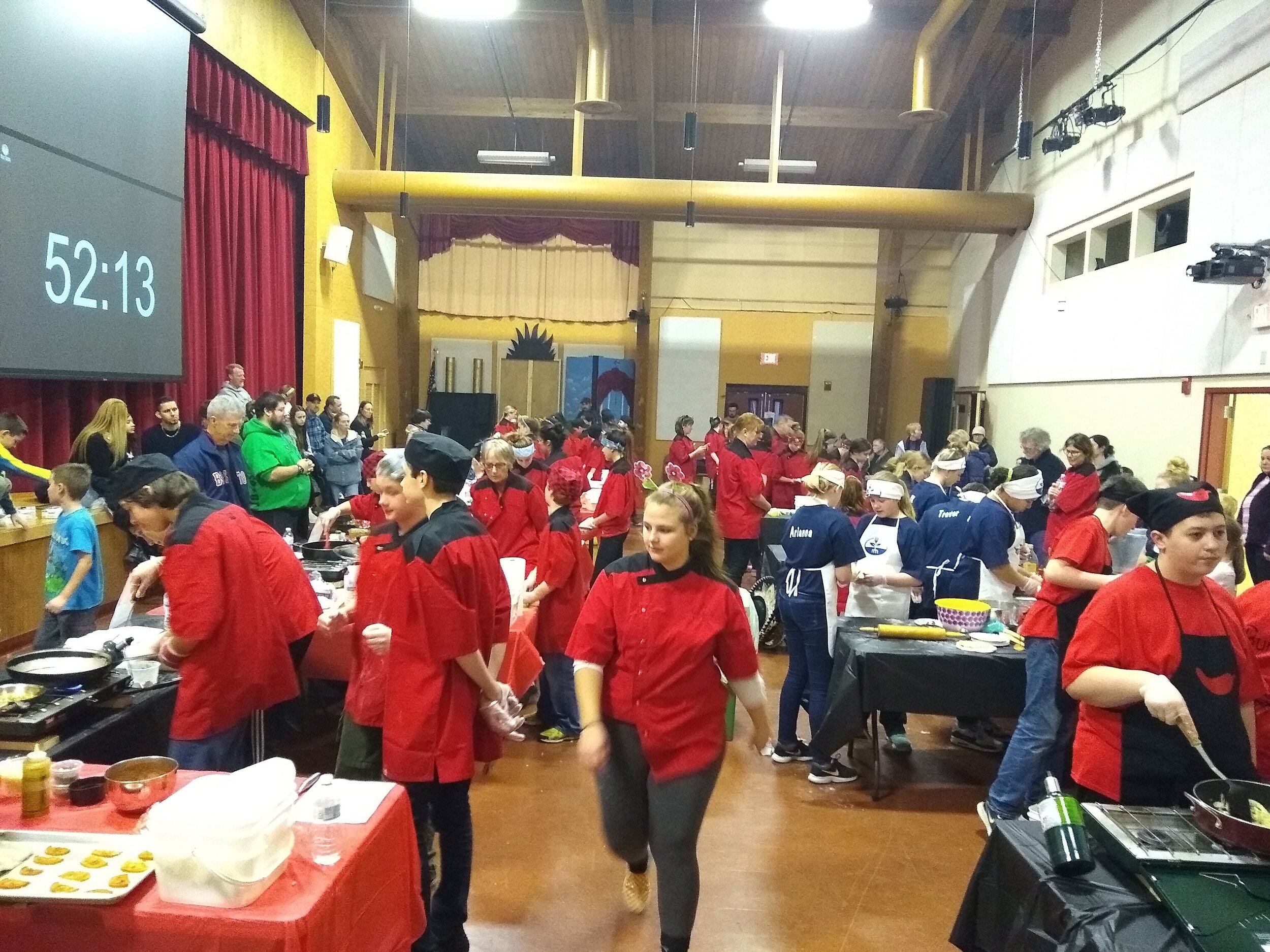
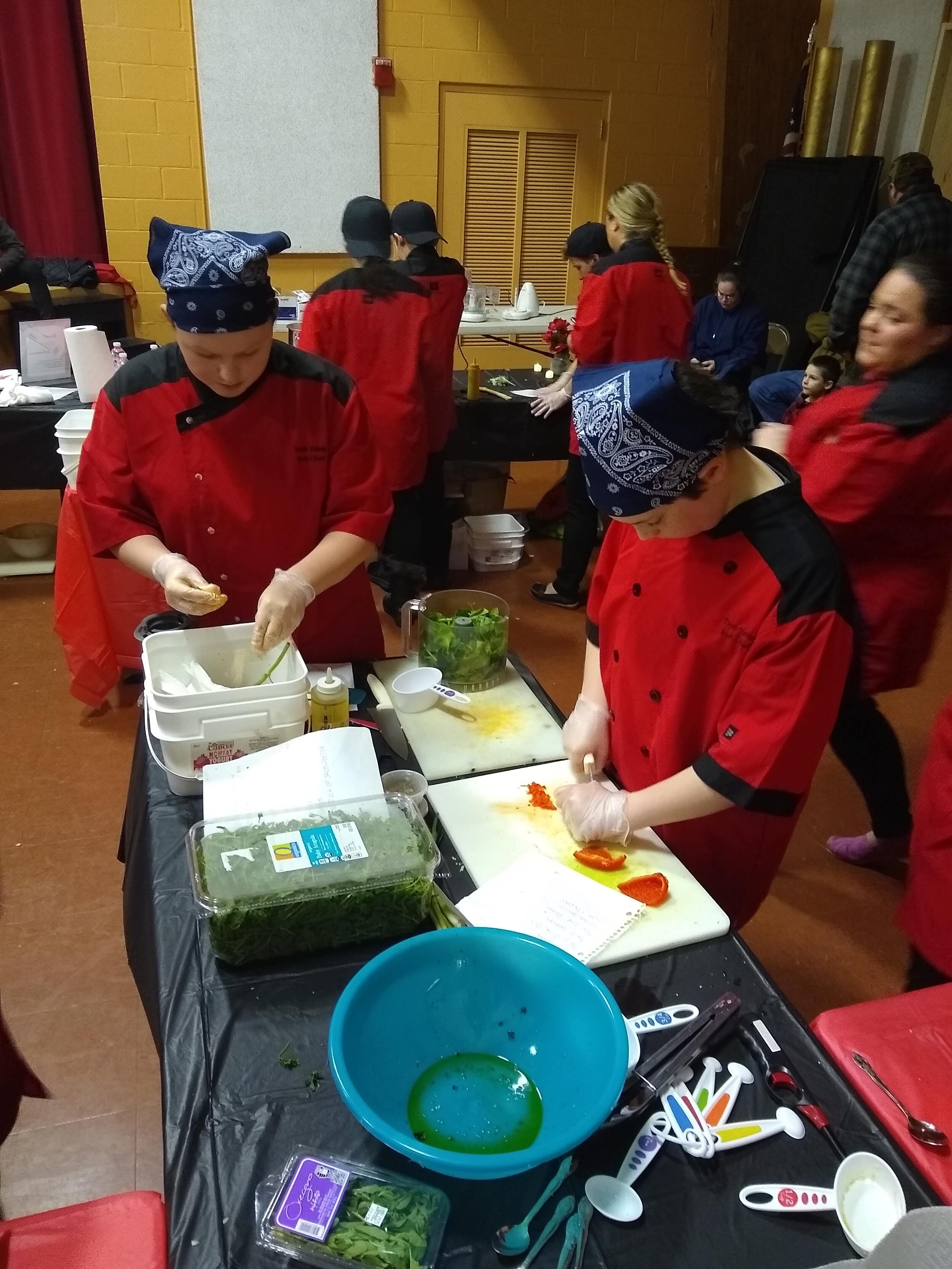


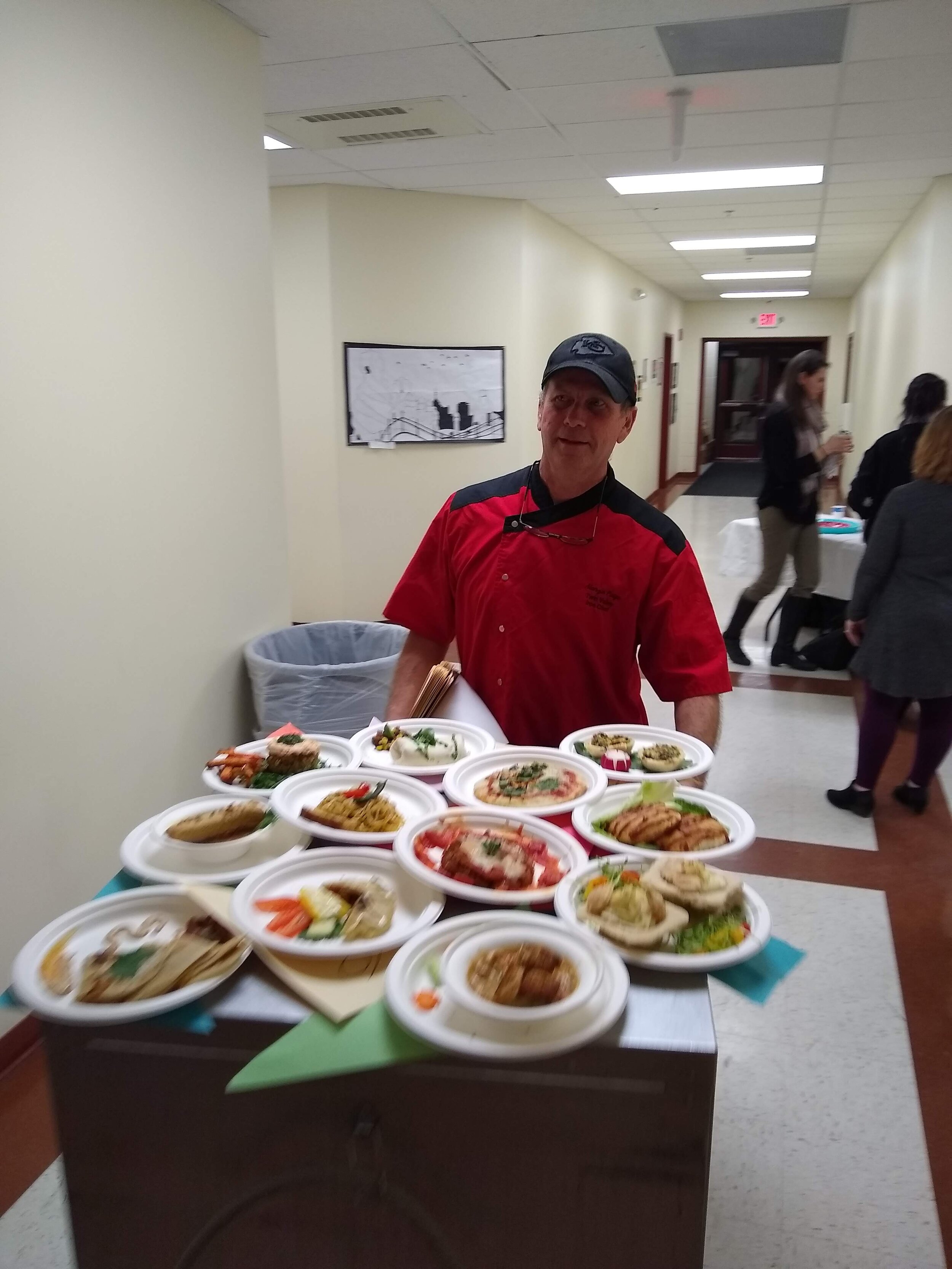
As mentioned in this month’s Cafeterias Unknown, increased student engagement is always a goal of Farm to School programs. Additionally, programming in middle and high schools is sometimes harder to implement due to stricter testing schedules, busier days for students, and less flexibility for the type of hands-on, project-based learning that is integral to Farm to School. We’ve seen some progress as schools move away from high-stakes testing. Food Connects is excited to better support middle and high school clubs focused on nutrition, agriculture, or the environment. But, as a newcomer to Junior Iron Chef VT, visiting the 2020 Cook-Off was inspiring and eye-opening. Here, older students were learning life-long skills and engaged in their local food systems in a competitive environment that had everyone on the edge of their seats as the winners were announced.
But, you don’t need to have a multi-team program to be a Junior Iron Chef competitor. Teams from Halifax, Kindle Farm, Flood Brook, Brattleboro, and Leland and Gray will all be heading up to Burlington to compete on March 14. All that’s needed is a volunteer coach and a group of interested students. With the growing popularity of cooking carts in area elementary schools, I also expect that a new wave of students will be entering middle and high school with an increased passion for cooking.
After kicking off the event, Lonny brought the six judges into what looked like the band room. Most of the judges had either coached or judged before, but Lonny gave an orientation for myself and any other newcomers in the room. Judging is broken down using a rubric, with categories such as Nutrition, Replicability, Taste, Appearance, Culinary Skill, and Mise en Place (tidiness, workstation organization) all being scored. All of the judge scores for a dish are added up for their total score of the night. For the remainder of the one and a half hours of cooking time, myself and the other judges roamed the auditorium, chatting with teams and observing as they completed what was possibly their seventh time making their recipes.
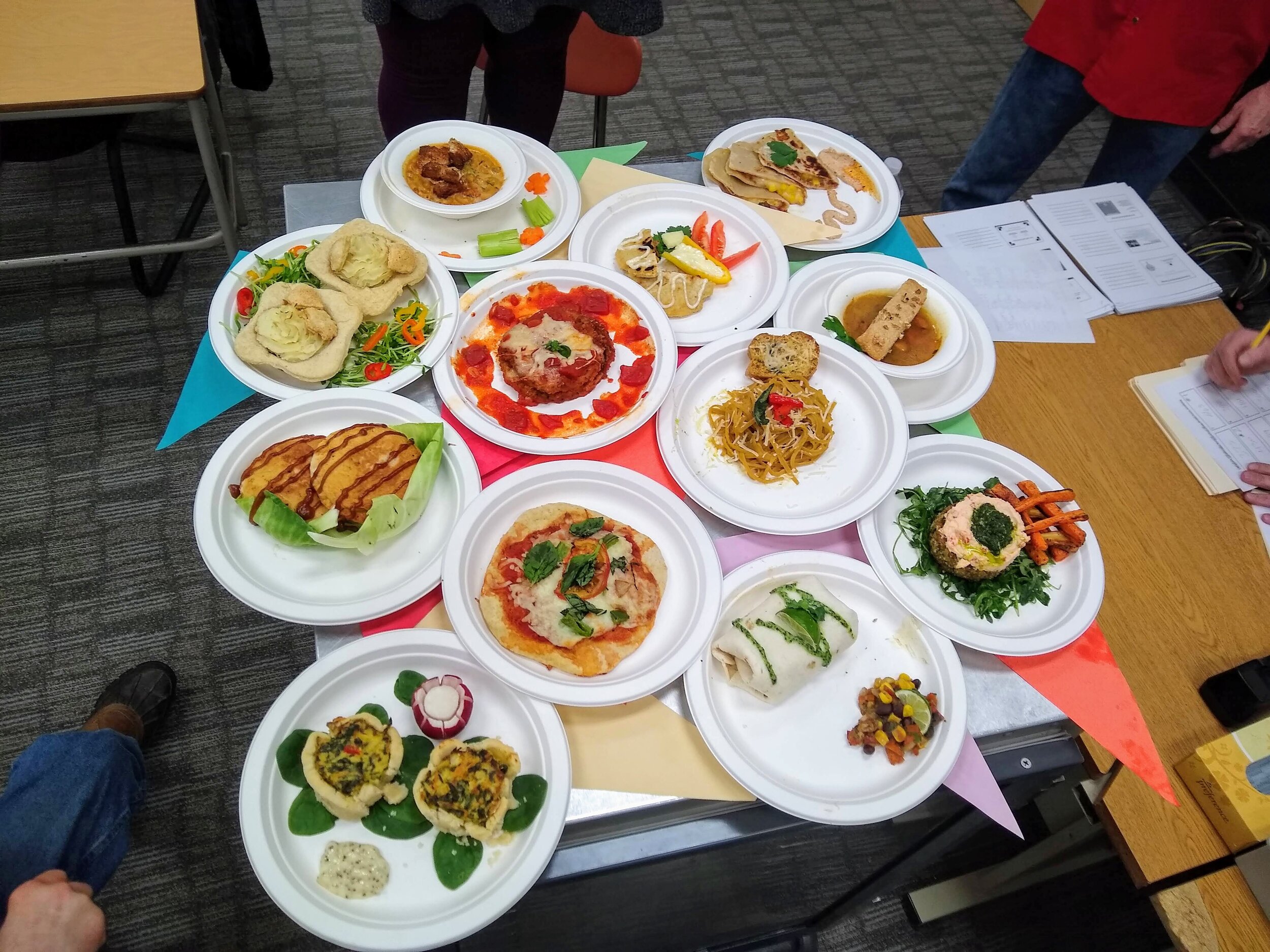
As the clock projected onto the stage neared zero, the six of us returned to the judge’s room to begin evaluating the dishes as they came in. I had not expected this part to be so difficult—every dish impressed. Teams used from scratch tortillas for quesadillas and homemade mayonnaise (all within the hour and a half timeframe). Teams had an eye for presentation and the six judges’ plates often looked just as good as the main plate. But, as we worked through the entries, some dishes stood out from the rest.
Notably, the first place dish from Snap, Crackle, Pop—Quinoa cakes with roasted red pepper ricotta and homemade pesto on a bed of greens. It tasted as good as it sounds and I was absolutely blown away that a middle school team made seven of these within the allotted time. It was restaurant quality and the team’s dedicated hard work was evident.
While only a few of the teams that competed will go on to the state competition, all the dishes were an impressive feat. Each team learned valuable cooking skills along the way and, I expect, have a greater appreciation for the food they’re served at school and when they eat out. What kept coming to mind as I watched the teams work was that these skills—scratch cooking, reading and altering recipes, knife work—will be skills they use every day for the rest of their lives. Farm to School can be many different things; for these middle and high school students, this is what it means to them.